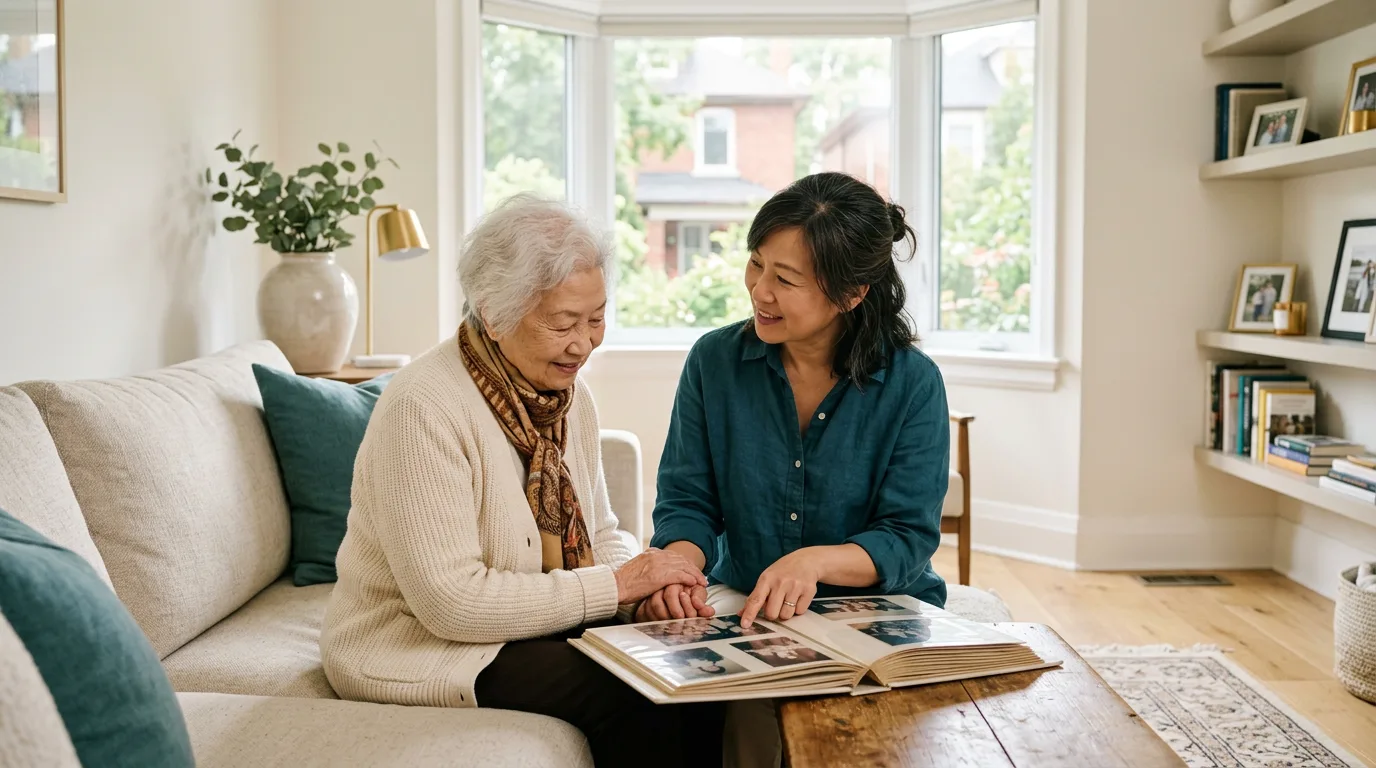
You notice it in pieces. The expired milk in the fridge that has been there for weeks. The same question — "What day is it today?" — asked three times in an hour, each time as though it is the first. The hydro bill, unpaid, sitting in a stack of unopened envelopes. None of these things alone means much. Together, they mean everything.
If you are a Toronto family watching a parent or spouse navigate the early signs of dementia, you are already carrying a weight that most people around you cannot see. You are Googling at midnight, trying to figure out what comes next — what is normal, what is not, what you should be doing, and whether your home is still a safe place for someone whose world is quietly shifting beneath them.
This guide is for you — and for the care teams who support families like yours. It walks through the full dementia care continuum, from early cognitive changes through advanced care needs, with practical tools you can use right now: a home safety walkthrough, a monthly assessment checklist, communication strategies by stage, cost projections, and Toronto-specific resources. Bookmark it, print it, and come back to it as things change — because they will change, and having a plan makes all the difference.
Key takeaway: Dementia care at home is not one decision — it is a series of decisions that evolve as the disease progresses. The families who navigate it best are the ones who understand the stage they are in, build the right support for that stage, and reassess regularly. This guide gives you the framework, the tools, and the Toronto-specific resources to do exactly that.
Understanding the Dementia Care Continuum
Dementia is not a single condition — it is a progression. What a family needs at the early stage looks nothing like what they need two or three years later. The most common mistake families make is building a care plan for where things are today without understanding where they are heading. The table below maps each stage to the level of support that is realistic at home, along with what families in the Greater Toronto Area can expect to pay.
| Stage | Cognitive Changes | Daily Care Needs | Typical Support Level | Toronto Monthly Cost Range |
|---|---|---|---|---|
| Early | Short-term memory lapses, word-finding difficulty, misplacing items, mild confusion in unfamiliar settings | Medication reminders, appointment management, light meal support, social engagement | Companion care, 4–8 hours/week | $500–$1,000/month |
| Moderate | Significant memory loss, confusion about time and place, personality changes, difficulty with familiar tasks, sundowning | Bathing and dressing assistance, meal preparation, medication management, supervision for safety, behavioural support | Personal support care, 15–25 hours/week | $2,000–$3,500/month |
| Advanced | Severe memory loss, limited or no verbal communication, difficulty recognising family, loss of motor function | Full personal care, feeding assistance, mobility and transfer support, continence management, 24-hour supervision | Near full-time or live-in care | $8,000–$15,000/month |
The transition between stages is gradual, not sudden. Most families operate in the space between two stages for months. The goal is not to predict exactly when someone will move from early to moderate — it is to build a care plan that can flex with them as they do.
Making Your Home Safe: A Room-by-Room Walkthrough
Home safety modifications are one of the highest-impact, lowest-cost interventions a family can make. Most can be completed in a single weekend. The checklist below is organised by room because that is how families actually walk through their homes when assessing risk.
| Room | Key Modifications | Why It Matters |
|---|---|---|
| Kitchen | Install automatic stove shut-off device; remove or lock away sharp knives and cleaning chemicals; simplify cupboard contents; add contrasting-colour placemats and dishware | The kitchen is the highest-risk room for burns, poisoning, and fires. Stove-related incidents are the most common trigger for families considering facility placement |
| Bathroom | Install grab bars near the toilet and in the shower; add non-slip mats; remove locks on bathroom doors (or switch to exterior-release locks); set water heater to a maximum of 49°C; use a raised toilet seat if mobility is declining | Falls in the bathroom account for a significant proportion of home injuries in seniors with dementia, and many happen during transfers to and from the toilet or tub |
| Bedroom | Install motion-sensor nightlights along the path to the bathroom; remove throw rugs; consider a bed rail or low-profile bed; keep a consistent layout — do not rearrange furniture | Nighttime disorientation increases fall risk, and unfamiliar room layouts compound confusion |
| Living areas | Remove clutter and excess furniture; secure loose cables and cords; lock away medications, batteries, and small objects that could be ingested; ensure good lighting throughout | Visual clutter increases agitation and confusion. Clear sightlines help the person navigate safely |
| Entrances and exits | Install door alarms or chime sensors on all exterior doors; add deadbolts that require a key from both sides; consider a door disguise (curtain or mural over the door surface); secure access to garages and basements | Wandering is one of the most dangerous dementia behaviours — 60% of people with dementia will wander at some point, and if not found within 24 hours, up to half will suffer serious injury or death |
Assistive Technology That Helps
Technology cannot replace human care, but the right tools can extend the hours of safety between care visits and give families real-time peace of mind. The options below are available in Canada and range from simple to sophisticated.
60% of people with dementia will wander at least once. GPS-enabled wearables and door sensors are not luxuries — they are safety infrastructure, and they should be in place before the first incident, not after.
| Technology | What It Does | Approximate Cost | Where to Find It |
|---|---|---|---|
| GPS tracker or wearable | Real-time location tracking for wandering prevention; some include fall detection and SOS buttons | $30–$60/month (device + subscription) | MedicAlert Safely Home, Apple AirTag (basic), dedicated GPS watches |
| Automatic stove shut-off | Detects unattended cooking or excessive heat and turns off the stove automatically | $300–$600 (one-time) | Available through home safety retailers and some Ontario Health atHome programs |
| Motion-sensor lighting | Activates lights automatically in hallways, bathrooms, and bedrooms to prevent nighttime falls | $15–$40 per sensor | Home hardware stores; no installation required for plug-in models |
| Door and window alarms | Alerts caregivers when exterior doors or windows are opened; can be connected to a smartphone | $20–$50 per sensor | Home hardware stores, smart home retailers |
| Automated medication dispenser | Pre-loaded device that dispenses the correct medication at the correct time; alerts if a dose is missed | $50–$100/month (rental) or $300–$800 (purchase) | Medipense, pharmacies with dispenser programs |
| Video monitoring | Allows family caregivers to check in remotely between visits | $30–$100 (camera) + optional cloud subscription | Consumer electronics retailers; discuss privacy considerations with your care team and your family member while they can still participate in the conversation |
Why Familiar Faces Matter: Caregiver Continuity in Dementia Care
In most types of home care, consistency is a preference. In dementia care, it is a clinical necessity. A person with dementia relies on routine, familiarity, and trust in ways that healthy adults do not — and those anchors erode every time a new face walks through the door.
When a caregiver is familiar, they notice the subtle changes: a slight shift in gait that signals a UTI before a fever appears, a change in appetite that precedes a medication side effect, the specific tone of voice that means agitation is building. A rotating cast of strangers cannot detect these patterns because they have no baseline to compare against.
This is why caregiver continuity matters more in dementia care than in any other context — and why families should ask any home care provider how they structure their teams. At Nurtura, every client is supported by a dedicated two-person team: a primary PSW who knows the client deeply and a consistent secondary who can step in seamlessly. The person with dementia sees the same faces, follows the same routines, and builds the kind of trust that makes care work.
How to Communicate Through Each Stage of Dementia
The way you communicate with someone who has dementia must change as the disease progresses. What works in the early stage — reasoning, reminding, correcting — becomes counterproductive in the moderate and advanced stages. The table below gives families and care teams a practical framework for adapting their approach.
| Stage | What Is Happening | Helpful Approaches | Phrases to Use | Phrases to Avoid |
|---|---|---|---|---|
| Early | The person is aware of their changes and may feel embarrassed, anxious, or frustrated. Communication is mostly intact but word-finding can be difficult | Be patient with pauses. Do not finish their sentences. Include them in decisions about their own care. Acknowledge their feelings without minimising | "Take your time — I'm not in a rush." / "What would you prefer?" / "That sounds frustrating. I understand." | "You already asked me that." / "Don't you remember?" / "It's not a big deal." |
| Moderate | Repetition, confabulation (filling memory gaps with invented details), difficulty following multi-step instructions, sundowning, possible paranoia or accusation | Use short, simple sentences. Offer two choices instead of open-ended questions. Redirect rather than correct. Join their reality rather than arguing with it. Use a calm, warm tone | "Would you like tea or coffee?" / "Let's go look at the garden." / "Tell me more about that." | "That didn't happen." / "I just told you." / "You need to stop doing that." |
| Advanced | Limited or no verbal communication. The person may not recognise family members. Emotional understanding often persists even when language does not | Use touch, eye contact, and tone of voice. Speak slowly and gently. Play familiar music. Narrate what you are doing. Watch for non-verbal cues — facial expressions, body tension, reaching | "I'm here with you." / "You're safe." / "I love you." (Even if they cannot respond, they often feel the warmth) | Quizzing ("Do you know who I am?"). Speaking about them in the third person while they are present. Using a loud or impatient tone |
Managing Sundowning
Sundowning — the pattern of increased agitation, confusion, and restlessness that occurs in the late afternoon and evening — affects an estimated 20 to 45 percent of people with dementia. It is one of the most common reasons families seek professional home care support, and one of the most exhausting patterns for caregivers to manage alone.
The exact cause is not fully understood, but it appears to involve disrupted circadian rhythms, fatigue, reduced lighting, and an accumulation of sensory stimulation throughout the day. While medication can help in some cases, environmental and behavioural strategies are the first line of defence.
Practical strategies for managing sundowning:
- Increase lighting in the late afternoon — open curtains, turn on lamps, avoid dim or shadowy rooms. Bright, even lighting can reduce confusion and agitation
- Schedule calming activities for the afternoon: gentle music, folding towels, looking at photo albums. Avoid stimulating activities, outings, or appointments after 2 PM
- Reduce noise and stimulation after 3 PM. Turn off the television news. Limit visitors. Create a quiet, predictable environment
- Maintain a consistent daily routine. Meals, activities, and bedtime at the same time every day helps anchor the person's sense of time
- Limit caffeine and sugar after noon
- Go outside in the morning. Natural light exposure earlier in the day helps regulate circadian rhythms
- If sundowning persists or escalates, speak with the care team about whether a medication review is appropriate. Some medications can worsen sundowning, and a geriatrician or neurologist can assess whether a pharmacological approach is warranted
Medication Management for Dementia
Medication management becomes increasingly complex as dementia progresses — and the risks of getting it wrong are serious. A person with moderate dementia may forget whether they have taken a dose, double up, or stop taking medication altogether without telling anyone. At the same time, they may be on multiple prescriptions that interact with each other in ways that worsen confusion, increase fall risk, or cause behavioural changes that families mistake for disease progression.
Common medication challenges in dementia care include:
- Compliance: Forgetting doses, taking medication at the wrong time, or refusing medication due to confusion or paranoia
- Drug interactions: Anticholinergic medications (found in some allergy, sleep, and bladder drugs) can worsen cognitive symptoms. Benzodiazepines increase fall and sedation risk. Even over-the-counter medications can interact with dementia drugs like donepezil or memantine
- Side effects mistaken for symptoms: New confusion, drowsiness, or agitation may be a medication side effect rather than disease progression — but families rarely think to check
What a home care team does differently: A professional caregiver can support medication adherence through timed reminders, blister pack monitoring, documentation of what was taken and when, and observation of side effects that family members might miss. This information flows back to the prescribing physician and pharmacist, creating a feedback loop that keeps the medication plan aligned with what is actually happening at home. Ask your pharmacist about blister packing — it is often available at no additional charge and dramatically reduces dosing errors.
Cultural Considerations for Toronto Families
Toronto is one of the most culturally diverse cities in the world, and dementia care does not happen in a cultural vacuum. Family expectations around caregiving, attitudes toward professional help, and even the way dementia is understood and discussed vary significantly across communities.
In many South Asian and Chinese families, multi-generational households are the norm, and there is a strong expectation that children — particularly daughters or daughters-in-law — will provide care for aging parents. Bringing a professional caregiver into the home can feel like a failure of family duty, even when the care needs have exceeded what one person can safely provide.
In Italian, Portuguese, and Greek communities in Toronto, similar expectations exist around family-centred care, often combined with a reluctance to discuss cognitive decline openly. Dementia may be described as "just getting old" rather than acknowledged as a medical condition requiring structured support.
In Caribbean and African communities, there can be additional layers: spiritual interpretations of cognitive changes, concerns about the cultural competence of care providers, and a deep-rooted preference for community-based support over institutional or agency-based care.
None of these perspectives are wrong. They are the context in which care decisions are made, and they matter. If your family is navigating these dynamics, here are two things worth knowing: first, professional home care does not replace family care — it supports it. A PSW who comes for four hours three times a week is not a substitute for a daughter's love; they are the reinforcement that keeps that daughter from burning out. Second, ask any home care provider whether they can match caregivers by language and cultural background. For families where the person with dementia has reverted to their first language — which is common in moderate and advanced stages — having a caregiver who speaks that language is not a luxury. It is a care requirement.
"Is Home Still Safe?" — A Monthly Assessment Tool
One of the hardest questions in dementia care is also the most important: is home still the right place? The answer changes over time, and families need a structured way to evaluate it — not in a crisis moment, but on a regular schedule. Use this 10-question assessment monthly. Score each area honestly.
For each area, score: 0 = No concern, 1 = Occasional concern, 2 = Frequent concern.
| # | Area | Your Score (0–2) |
|---|---|---|
| 1 | Wandering: Has your family member attempted to leave the home unsupervised or been found in an unfamiliar location? | |
| 2 | Falls: Have there been falls, near-falls, or unsteadiness that was not present previously? | |
| 3 | Medication errors: Have doses been missed, doubled, or refused? Have you found medications in unusual places? | |
| 4 | Nutrition: Is your family member eating and drinking adequately? Have they lost weight or shown reduced interest in meals? | |
| 5 | Hygiene: Are they resisting bathing, grooming, or changing clothes? Is personal hygiene declining noticeably? | |
| 6 | Caregiver capacity: Are you — the primary caregiver — sleeping, eating, and maintaining your own health? Are you at or past your limit? | |
| 7 | Social engagement: Has your family member withdrawn significantly from social interaction, activities, or conversation? | |
| 8 | Sleep disruption: Are nighttime awakenings, wandering, or agitation disrupting sleep for the person with dementia or for you? | |
| 9 | Agitation and behavioural changes: Are episodes of aggression, paranoia, or severe agitation increasing in frequency or intensity? | |
| 10 | Appliance and home safety: Have there been incidents involving the stove, oven, taps, or other household appliances being left on or used unsafely? |
Add up your scores. Your total will fall into one of three ranges:
| Score Range | What It Means | Recommended Action |
|---|---|---|
| 0–7 | Current plan is working — continue with existing support and reassess next month | Maintain current care schedule. Continue monthly reassessment. Review home safety modifications |
| 8–14 | Increasing concern — current support may not be sufficient | Increase care hours. Address the highest-scoring areas specifically. Consult with the care team about adjustments. Reassess in two weeks, not one month |
| 15–20 | Home-based care is under significant strain | Have an honest conversation with your care team about whether home remains the safest setting. Explore memory care and long-term care options — not as a failure, but as a plan |
When Home Care Is No Longer Enough
There is no universal threshold where home care stops being viable. For some families, home-based care works through every stage with the right level of professional support. For others, the combination of safety risks, caregiver exhaustion, and 24-hour supervision needs makes a memory care unit or long-term care home the better — and sometimes the safer — choice.
This is not a failure. It is a recognition that the disease has progressed beyond what any home environment can safely accommodate, regardless of how much the family loves the person, how much money they spend, or how hard they try.
If you are approaching this decision, two things can help. First, talk to families who have already made the transition. The guilt is real, but so is the relief when the person with dementia is in a setting designed for their level of need, with staff trained specifically in memory care. Second, use the monthly assessment tool above to ground the decision in evidence rather than emotion. When three or more areas consistently score at the "frequent concern" level, or when a critical safety event occurs, the conversation has shifted — and it is time to respond.
Toronto Resources for Dementia Families
Toronto families have access to some of the strongest dementia support infrastructure in Canada. These are the organisations and programs worth knowing about.
| Resource | What They Offer | Contact |
|---|---|---|
| Alzheimer Society of Toronto | First Link referral program, caregiver education, support groups, counselling, social recreation programs for people with dementia | 416-322-6560 / alzheimertoronto.org |
| Baycrest Health Sciences | Adult day programs specialised for dementia, geriatric assessment, caregiver wellness programs, research-based brain health resources | 416-785-2500 / baycrest.org |
| Ontario Health atHome | Publicly funded home care coordination, nursing, personal support, and specialised dementia care streams; gateway to long-term care placement | 310-2222 (no area code needed anywhere in Ontario) |
| Geriatric assessment clinics | Comprehensive cognitive assessment, diagnosis, care planning, and medication management by geriatricians — available at Sunnybrook, Baycrest, Mount Sinai, and other GTA hospitals | Referral through your family physician |
| Ontario Caregiver Organization | Free coaching, navigation support, peer-led caregiver communities, and employer resources for family caregivers across Ontario | 1-833-416-2273 / ontariocaregiver.ca |
A Note for the Care Teams Who Share This Guide
If you are a discharge planner, pharmacist, geriatrician, family physician, or anyone who works with families navigating dementia — this guide was written to be shared. Print it, email it, include it in a discharge package, or hand it to the adult child who is standing at your counter looking lost.
Dementia is the conversation every care professional encounters but few feel fully equipped to address in a five-minute interaction. You do not need to have all the answers. You just need to have something concrete to offer — a resource that covers what happens next, what it costs, and where to turn for help. That is what this guide is for.
Families remember the professional who handed them the right information at the right time. Not a pamphlet — a real guide, with real tools, written for real families. If you are working with a family who has just received a dementia diagnosis, or who is struggling with a parent's worsening cognitive symptoms, or who is asking whether their home is still safe, share this guide. It will not answer every question, but it will give them a framework for the decisions ahead — and that is more than most families have when they start this journey. For families who are also navigating a hospital discharge, our 72 Hours After Discharge guide provides the tactical day-by-day checklist for the transition home.
Frequently Asked Questions
How much does dementia care at home cost in Toronto?
Costs scale with disease progression. Early-stage companion care (4 to 8 hours per week) runs approximately $500 to $1,000 per month. Moderate-stage personal support (15 to 25 hours per week) costs $2,000 to $3,500 per month. Advanced-stage near full-time or live-in care ranges from $8,000 to $15,000 per month. Ontario Health atHome may cover some hours at no cost — call 310-2222 to request an assessment. For a full breakdown of funding sources and tax credits that can reduce your out-of-pocket costs, see our Complete Financial Playbook.
When is home care no longer enough for someone with dementia?
Use a monthly safety check covering wandering incidents, falls, medication errors, nutrition, hygiene, and caregiver capacity. When three or more areas consistently score as concerning — or a single critical safety event occurs, such as leaving the stove on or leaving the home unsupervised — it is time to consult with the care team about memory care or long-term care options. The "Is Home Still Safe?" assessment tool in this guide provides a structured 10-question framework families can use each month to ground this decision in evidence rather than emotion.
What home safety modifications are needed for dementia care?
Key modifications include door alarms and locks to prevent wandering, automatic stove shut-offs, motion-sensor nightlights for fall prevention, removal of throw rugs and clutter, bathroom grab bars, locked medicine and cleaning supply storage, and simplified room layouts that reduce confusion. A room-by-room safety assessment is the essential first step — most modifications can be completed in a single weekend and cost under $500 total. The safety walkthrough in this guide covers kitchen, bathroom, bedroom, living areas, and entrances with specific recommendations for each.
Maria Wallace
Founder & Clinical Director, RN, M.Ed., Ph.D.